February 2026 |
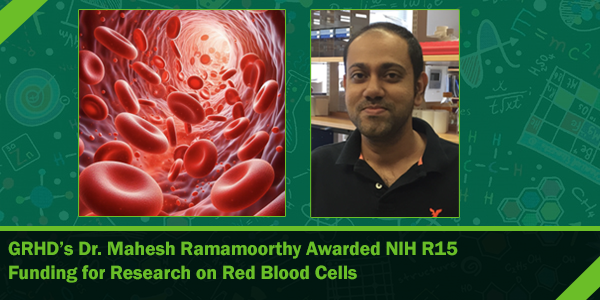
Dr. Mahesh Ramamoorthy, an assistant research professor in the Center for Gene Regulation in Health and Disease (GRHD), has received $552,736 in new funding from the NIH for his research studying the function of red blood cells. This three-year R15 award from the National Institute of Diabetes and Digestive and Kidney Diseases (NIDDK) will support Dr. Ramamoorthy's scientific research as well as the training of undergraduate researchers in his lab.
Human red blood cells are flexible, doughnut-shaped discs that carry oxygen throughout the body. These cells do not have a nucleus and instead use that space for extra oxygen-carrying proteins (hemoglobin). Terminal erythropoiesis is the final stage of red blood cell development in bone marrow - when the cell sheds its nucleus and fills with hemoglobin for oxygen binding and then migrates into the bloodstream. If erythropoiesis does not occur correctly, it can lead to conditions like anemia and thalassemia.
There is evidence that mutations in the Stag1 protein are tied to abnormal blood cell growth, and Dr. Ramamoorthy will study the role that the Stag1 plays during terminal erythropoiesis.
|
REMINDER: CAREER Award Workshop for Junior Faculty The Office of Research will be hosting a workshop and Q&A forum for junior faculty to learn more about the prestigious CAREER award. Junior faculty are encouraged to attend if they are considering applying for a CAREER award. The Faculty Early Career Development Program (CAREER) award is managed by the National Science Foundation (NSF). The CAREER Program is a Foundation-wide activity that offers the NSF's most prestigious awards in support of early-career faculty who have the potential to serve as academic role models in research and education. The workshop will be held on Monday, February 23 from 2:30 pm to 3:30 pm and will be led by 3 recent CAREER awardees from CSU. To register for the workshop, click here. |
 |

UPDATE: Patent Review Committee Approval The CSU Patent Review Committee reviewed and approved an invention disclosure submitted by Dr. Peng Jiang, an assistant professor in the Department of Biological, Geological, and Environmental Sciences (BGES) and a member of the Center for Gene Regulation in Health and Disease (GRHD), titled: Seq2Pheno: An AI-driven Tool to Impute Tissue Phenotypes From RNA-seq Data for filing as a provisional patent application. Histology is labor-intensive, costly, and often unfeasible for frozen or archived biobank specimens. Seq2Pheno addresses the labor-intensive and costly histology procedures on biobank specimens. The invention uses artificial intelligence and machine learning (AI/ML) to transform RNA sequencing data into quantitative, histology-comparable tissue phenotypes. |
TeCK Fund Phase 4 Accepting Letters of Intent The TeCK Fund, a technology commercialization and startup fund managed by Cleveland State University Research Corporation, continues to accept Letters of Intent for the opportunity to submit a full proposal. The TeCK Fund Round 4 provides faculty pursuing applied research projects with funding to assist with commercialization activities, including prototype creation, third-party validation, and market research, which are required to successfully spin off technologies. Applicants are strongly encouraged to participate in an I-Corps program prior to applying. |
- NASA issues guidance requiring research security training for all research grants
- Cleveland State University physics major Josh Hoeflich wins top physics art prize at the 2025 Physics and Astronomy Congress
- CSU Law Professor Milena Sterio Recognized Among Top 100 International Law Scholars
- CSU Spring Dance Concert February 20-22 at Playhouse Square's Allen Theatre
- CSU Ph.D. student Temitope Adeniyi recognized as part of the United Nations Educational, Scientific and Cultural Organization (UNESCO) Quantum 100

© 2026 - Cleveland State University - Office of Research |


